


Nest Notes
What Happens If You Don’t Qualify for a Mortgage When Buying a New Home?

July 23, 2026
Not qualifying for a mortgage doesn’t mean you’re bad with money, and it doesn’t mean you can never buy a home. Here’s what actually happens if you don’t qualify.
For a lot of buyers, this is the part that keeps them stuck. They like the idea of a new home. They may even be ready to tour communities, compare floor plans, and think seriously about monthly payment. But one fear sits underneath all of it: what if I try, and the lender says no?
Mortgage qualification is not a judgment on your character. It’s a lender reviewing a specific set of numbers, documents, and guidelines at a specific point in time. Sometimes the answer is yes right away. Sometimes it’s not yet. That’s the difference that matters.
In this guide, we’ll walk through what happens if you don’t qualify for a mortgage, why a new home mortgage can be denied, what lenders actually look at, what may happen to your deposit, and what your next steps can look like. We’ll also explain how Garman Pathways™ can offer extra peace of mind with a $1,000 refund guarantee, based on current program terms. As always, we recommend confirming current details with our team.
Key Takeaways
- Not qualifying for a mortgage is usually about timing, documentation, or lender guidelines, not personal failure.
- Lenders look closely at credit score, debt-to-income ratio, employment history, down payment, and cash reserves.
- Common mortgage denial reasons include a credit score just below the threshold, debt that is slightly too high, a recent job change, limited cash to close, or self-employment income complexity.
- If you don’t qualify, the most useful next step is to ask exactly what needs to improve and by how much.
- A realistic 6 to 12 month plan can often put buyers in a much stronger position.
- Different lenders use different overlays and loan products, so a second opinion can matter.
- Builder-preferred lenders often understand new construction timelines better and can help create a more practical path forward.
- Under Garman Pathways™, the initial $1,000 deposit is refundable if you do not qualify for financing, subject to current program terms and verification.
What happens if you don’t qualify for a mortgage?
If you don’t qualify for a mortgage, the home purchase usually pauses or stops until financing is resolved. That does not automatically mean the door is closed for good. In many cases, buyers can improve one or two financial factors, work with a different lender, or use a different loan program and come back stronger.
That short answer matters because buyers often assume a denial means they should walk away from homeownership entirely. It usually means something more specific: the loan file does not meet that lender’s approval standards today.
With new construction, timing matters too. Some buyers don’t qualify at the start. Others qualify later after paying down debt, documenting income more clearly, or saving more cash. A denial is a snapshot. It is not your permanent status.
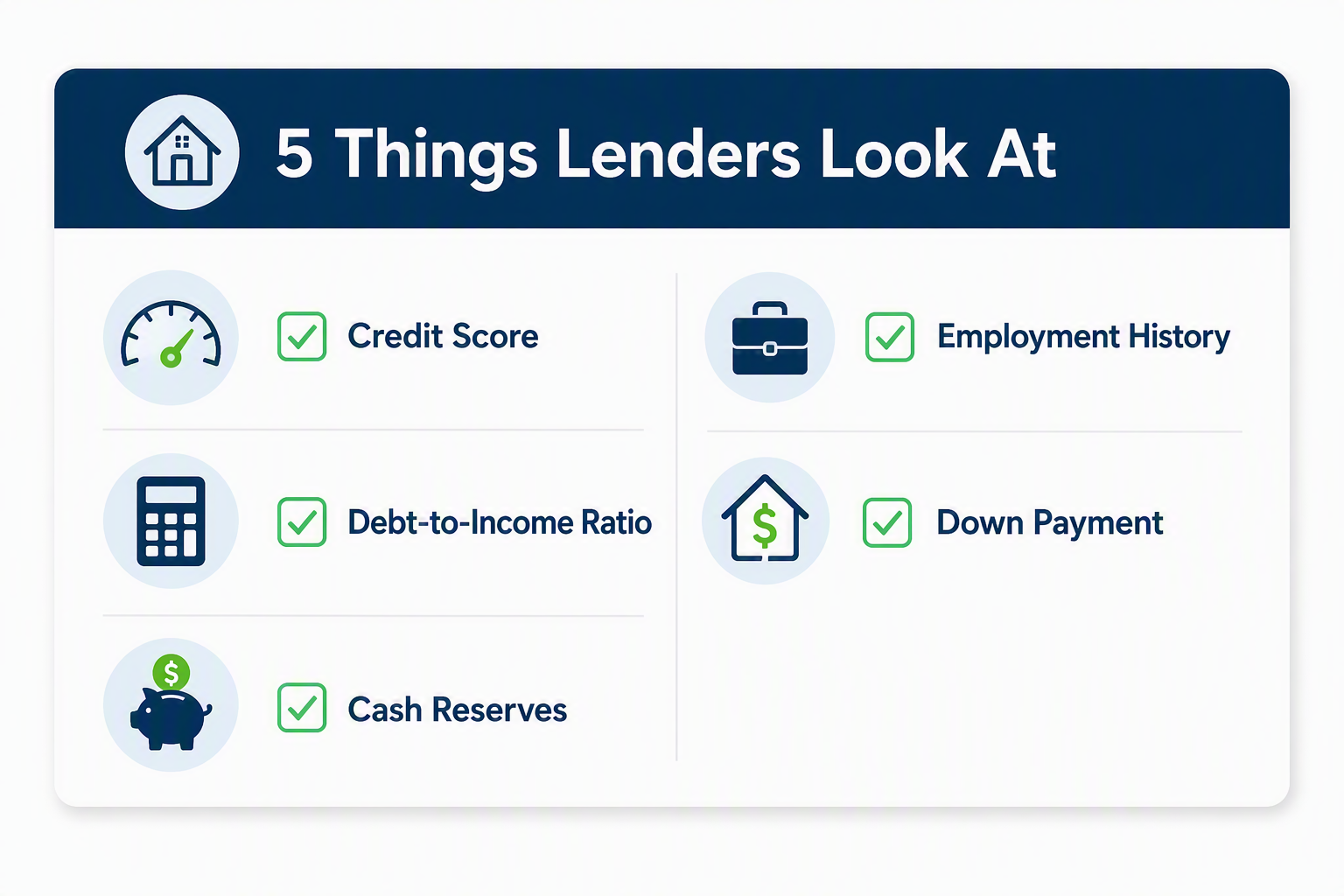
What lenders actually look at
When buyers ask why they didn’t qualify for a mortgage, the answer usually comes back to five core areas. Lenders are trying to measure risk and ability to repay. That’s it.
Credit score
Your credit score helps lenders gauge how you’ve handled debt in the past. It can affect whether you qualify at all, which loan programs are available, and what interest rate you may receive.
A score that is only slightly below the requirement can still cause a mortgage pre-approval to be denied. That does not mean your credit is wrecked. Sometimes it means you are close, just not over the line yet.
Debt-to-income ratio
Debt-to-income ratio, often called DTI, compares your monthly debt payments to your gross monthly income. This includes things like car loans, student loans, credit cards, and the projected housing payment.
A buyer can earn a solid income and still run into trouble here. If monthly obligations are already too high, the lender may decide the new payment pushes the file beyond its guidelines.
Employment history
Lenders want to see stable, documentable income. That often means a consistent work history and clear pay records.
A recent job change does not automatically ruin your chances, but it can create extra questions. The same goes for variable income, commission pay, bonuses, or recent shifts from W-2 employment to self-employment.
Down payment
Some loan programs require only a small down payment. Others require more. Either way, lenders want to know you have enough funds available for the down payment and closing costs.
A buyer can be financially responsible and still fall short here. Saving is hard, especially when rent, childcare, and everyday costs keep climbing.
Cash reserves
Some lenders also want to see reserves, meaning money left after closing. That extra cushion shows you can handle the cost of homeownership even if something unexpected comes up.
This catches buyers off guard all the time. They plan carefully for the down payment and closing costs, then learn the lender also wants to see money still in the bank.
The most common reasons buyers don’t qualify
These are the mortgage denial reasons we see most often. None of them are moral failings. They are financial or documentation issues that usually have a clear explanation, and often, a fix.
The credit score is just below the threshold
This is one of the most frustrating outcomes because it often means the buyer was close. Maybe a credit card balance was higher than usual. Maybe there was one late payment. Maybe the score simply hasn’t recovered yet from an older issue.
That’s not the same as being irresponsible. It means the lender’s model wants to see a little more strength before approving the file.
Debt-to-income ratio is slightly too high
This is common for buyers with student loans, vehicle payments, or revolving debt. Even if you’ve never missed a payment, your ratios can still come in too high for the program.
In other words, the issue may not be whether you pay your bills. The issue may be whether the projected new payment fits inside the lender’s formula.
Recent job change
A new role, a shift in pay structure, or a move into self-employment can complicate qualification. Sometimes the income is real and strong, but the lender cannot count it yet under current guidelines.
That is especially frustrating for buyers whose earnings have improved. On paper, things are better. Underwriting may still need more time or more documentation.
Insufficient down payment or cash to close
Some buyers qualify based on income and credit but fall short on available cash. This can mean not enough for the down payment, not enough for closing costs, or not enough to satisfy reserve requirements.
That does not mean buying is out of reach forever. It means the cash side of the equation needs work.
Self-employment income is harder to document
Self-employed buyers often earn enough to buy. The problem is proving a stable qualifying income in the way the lender needs to see it.
Write-offs, fluctuating revenue, and year-to-year changes can all reduce the income lenders are willing to use. This is a documentation issue as much as an income issue, which is why a lender who understands complex files matters.
What happens with your deposit if you don’t qualify?
This is one of the first questions buyers ask, and they should. If a new home mortgage is denied, they want to know what they stand to lose.
Under Garman Pathways™, the initial $1,000 deposit is refundable if you do not qualify for financing, based on current program terms. That piece matters because it lowers the pressure around taking the first step. Buyers can move forward with more confidence, knowing they are not risking that initial deposit if financing does not come together.
We say “based on current program terms” for a reason. Programs can change, and specific situations can have conditions attached. Before you rely on any deposit protection, talk with our team and confirm the current Garman Pathways™ details in writing.
Still, the bigger point stands: we know financing uncertainty is real. That’s exactly why a program like this matters.
What to do next if you don’t qualify
A mortgage denial feels personal, even when it isn’t. The best response is not panic. It’s a plan.
1. Ask the lender exactly what needs to improve
Do not settle for a vague “you don’t qualify right now.” Ask specific follow-up questions.
You want to know:
- Is the issue credit score?
- Is the issue debt-to-income ratio?
- Is the issue cash to close?
- Is the issue employment history?
- Is the issue documentation?
Then ask the next question: how far off am I?
That answer gives you something concrete to work on. “Your score needs to be 20 points higher” is useful. “You need to pay off this card” is useful. “We need another year of self-employment tax returns” is useful. Vague answers are not.
2. Give yourself a 6 to 12 month runway
Most buyers do not need a total financial overhaul. They need time to improve one or two specific areas.
That might mean paying down revolving debt, avoiding late payments, building savings, or letting a job change season long enough to satisfy underwriting. Six months can make a real difference. Twelve months can change the whole file.
Treat it like a build-up period, not a failure period.
3. Get a second lender opinion
This matters more than buyers realize. Different lenders have different overlays, loan products, and comfort levels with certain files.
A first lender may say no to a self-employed borrower. A second lender may know exactly how to structure the review. A first lender may be stricter on reserves. A second may offer a better-fit program.
If you’re asking, “Why didn’t I qualify for a mortgage?” the answer may partly be, “with that lender.”
4. Consider co-signers or partner-buyers where appropriate
This is not the right fit for everyone, but in some cases, a co-signer or co-borrower can strengthen the file. That can help with income, reserves, or overall qualification.
It only works when everyone involved fully understands the responsibility. This is not a casual fix. But when it makes sense, it can open a door that was closed before.
5. Explore first-time buyer programs and specialized loan options
Loan fit matters. So does program knowledge.
Depending on your situation, it may be worth exploring:
- First-time buyer programs
- PHFA loans
- VA loans, if eligible
- Other low down payment options
Not every buyer needs the same mortgage path. If you want a better foundation before meeting with a lender, our blog on Different Types of Mortgage Loans is a good place to start.
Why builder-preferred lenders can help
Builder-preferred lenders are not automatically the right answer for every buyer, but they can be especially helpful with new construction.
They understand the build timeline. They understand how deposits, rate locks, and settlement schedules work. And they often know how to look past a simple yes-or-no screen and map out what needs to happen next.
That last part is important.
A generic lender may tell you no and move on. A lender who works regularly with new construction buyers is more likely to explain what’s missing, what can be improved, and whether a different loan structure could work better. That creates a real path forward.
At Garman, we want buyers to have more control and more confidence. The right lending partner helps with both.
What not to do if you don’t qualify
When buyers hear bad news, the instinct is often to do something fast. Usually, fast is the wrong move.
Don’t panic-open new credit lines
Opening new credit can lower your score, change your debt profile, and create more confusion in the file. It rarely helps in the short term.
Don’t move money around unnecessarily
Large unexplained transfers can create documentation headaches. If a lender is already reviewing your finances closely, extra movement can make things harder to verify.
Don’t give up entirely
This is the biggest one.
A mortgage pre-approval denied today does not mean a mortgage denied forever. Buyers get approved later all the time. The smart move is to understand the reason, improve the weak spot, and keep your timing realistic.
The Garman perspective
Our sales team’s job is not to reject people. It’s to help people become buyers when the time is right.
Sometimes that means helping someone move forward now. Sometimes it means helping them understand what needs to happen first. We take that seriously because buying a home is a major decision, and nobody benefits from pressure or false promises.
That’s part of what we mean by a smarter way forward.
We want buyers to understand the process, protect their options, and feel supported from the first conversation on. If financing is the part that feels uncertain, we’d rather talk about it honestly than pretend it isn’t a factor.
Garman Builders is Here to Help
At Garman Builders, we believe in giving buyers more value, more control, and more confidence. That includes honest conversations about qualification, practical next steps, and tools like Garman Pathways™ that can reduce the pressure of getting started.
If you’re thinking about buying a new home in South Central Pennsylvania and want a clearer sense of where you stand, contact our team. We’ll help you understand your options, connect you with the right resources, and take the next step at the right pace for you.
FAQ: Mortgage Qualification for New Construction Buyers
Can I buy a new construction home if I was denied for a mortgage?
Yes, you may still be able to buy a new construction home later, even if you were denied now. Mortgage denials are often tied to timing, debt ratios, credit thresholds, or documentation issues. Once those specific issues improve, many buyers are able to qualify and move forward.
What happens if I don’t qualify for a mortgage after signing for a new home?
If you don’t qualify for a mortgage after signing for a new home, the contract usually cannot move forward unless financing is resolved. Under Garman Pathways™, the initial $1,000 deposit is refundable if you do not qualify for financing, based on current program terms. Always confirm current details with our team.
Does a mortgage denial mean I’m bad with money?
No. A mortgage denial means your file did not meet a lender’s guidelines at that time. It can happen because of credit score, debt-to-income ratio, recent employment changes, reserve requirements, or income documentation. Those are underwriting issues, not character judgments.
Why didn’t I qualify for a mortgage if I pay my bills on time?
Paying bills on time helps, but lenders review more than payment history. They also look at your credit score, debt levels, available cash, employment history, and how your income is documented. You can be financially responsible and still miss one underwriting requirement.
How long should I wait before applying again after a mortgage denial?
That depends on the reason for the denial. Some buyers are ready to apply again in a few months. Others need 6 to 12 months to improve credit, reduce debt, save cash, or document income more clearly. Ask the lender for a specific timeline based on your file.
Should I talk to another lender if I was denied?
Yes. Getting a second lender opinion is often worth it. Different lenders have different program options, overlays, and levels of experience with self-employment income, new construction, or lower down payment financing. A second review can reveal a path the first lender missed.
Can a recent job change cause a mortgage pre-approval to be denied?
Yes. A recent job change can affect mortgage qualification, especially if it changed your pay structure, moved you into self-employment, or created gaps in documentable income. It does not always stop approval, but it can trigger more scrutiny from underwriting.
What should I do first if I don’t qualify for a home loan?
Start by asking the lender exactly why the file was denied and what needs to improve. Get details on credit score, debt-to-income ratio, cash to close, or income documentation. Once you know the specific issue, you can build a practical plan instead of guessing.
Are builder-preferred lenders easier to qualify with?
Not necessarily easier, but often more helpful. Builder-preferred lenders usually understand new construction timelines, contract structure, and financing milestones better. That often leads to better guidance, clearer expectations, and a more realistic path forward if you are close to qualifying.
What loan programs should I ask about if I don’t qualify right away?
Ask about first-time buyer programs, PHFA loans, VA loans if eligible, and other low down payment options. The right loan type can make a meaningful difference in qualification. Program fit matters just as much as income and credit in many cases.
A better next step starts with clarity
If financing is the part that’s holding you back, you are not alone, and you are not out of options. Most buyers do better once they understand what lenders are actually looking for and where they stand today.


 0
0