


Nest Notes
How Much House Can I Afford? What Actually Determines Your Budget?

July 28, 2026
The “3x your income” rule gets repeated a lot because it’s simple. It’s also incomplete.
If you’re trying to figure out how much house can I afford, your salary is only one piece of the answer. What matters more is how your full monthly picture comes together, including your debt, your down payment, current interest rates and the taxes and insurance tied to where you want to live.
That’s why buyers can earn the same income and end up with very different price ranges.
In this guide, we’ll walk through the real factors that shape affordability, explain debt-to-income in plain English and show you how to move from guesswork to actual numbers. If you want the practical next step, use our Buyer Power Calculator to estimate your budget based on your real situation.
Key Takeaways
- The “3x income” rule is a starting point, not a reliable answer.
- The biggest affordability factors are income, monthly debt, down payment, interest rate, property taxes and homeowners insurance.
- Most lenders want your total monthly debt payments, including your future mortgage, to stay below 43% of gross monthly income.
- Interest rate changes matter fast. On a $400,000 loan, a 1% rate difference can change your payment by roughly $250 per month.
- Down payment minimums vary by loan type, and your down payment also affects PMI and your monthly payment.
- Property taxes and insurance can shift your true monthly cost depending on which South Central PA county you choose.
- There’s a real difference between what you can qualify for and what will feel comfortable month to month.
- Our Buyer Power Calculator helps you estimate purchase power and monthly payment before you talk to a lender.

The Rule of Thumb Misses What Buyers Actually Need
When buyers ask, “How much home can I afford?” they’re usually not asking for a broad estimate. They’re asking a much more practical question:
What can I buy without stretching myself too thin every month?
That answer doesn’t come from one salary multiplier. It comes from your full financial picture.
A buyer earning $120,000 a year with no car payment and strong savings will not land in the same range as a buyer earning $120,000 a year with student loans, credit card balances and a smaller down payment. On paper, the income is identical. In real life, the buying power is not.
That’s why a good home affordability calculator is more useful than a rule of thumb. It helps translate your actual numbers into a more realistic monthly budget and price range.
The 5 Real Factors That Affect Home Affordability
1. Gross monthly income
This is your income before taxes and deductions. Lenders start here because it gives them a consistent way to measure capacity.
If your household earns $96,000 per year, your gross monthly income is $8,000. That number becomes the base for affordability calculations.
If you have multiple household incomes that will be used on the loan, those can increase buying power. But income alone never tells the full story.
2. Monthly debt payments
This is where affordability gets real.
Lenders look at your recurring monthly obligations, including car loans, student loans, minimum credit card payments and other installment or revolving debt. These payments directly affect how much room is left for a mortgage.
Two buyers with the same income can end up in very different price ranges just because one has $300 in monthly debt and the other has $1,200.
3. Down payment amount
Your down payment affects more than just your upfront cash needed to buy.
A larger down payment lowers the loan amount, which lowers your monthly principal and interest payment. It can also reduce or eliminate private mortgage insurance, depending on the loan type and your loan-to-value ratio.
A smaller down payment doesn’t mean you can’t buy. It does mean your monthly payment may be higher than you expect.
4. Current interest rates
Rate changes move the monthly payment faster than most buyers realize.
Even if the home price stays the same, a higher interest rate can reduce your buying power or push a monthly payment out of your comfort zone. This is one reason today’s buyers need current numbers, not old assumptions.
We’ll break this down more in a moment, because it matters a lot.
5. Property taxes and homeowners insurance
These costs are often underestimated by buyers focused only on principal and interest.
Your full monthly housing payment usually includes:
- Principal
- Interest
- Property taxes
- Homeowners insurance
- Mortgage insurance, if applicable
- HOA fees, if applicable
That means the same home price can produce a different monthly payment depending on where you buy and how the home is insured.
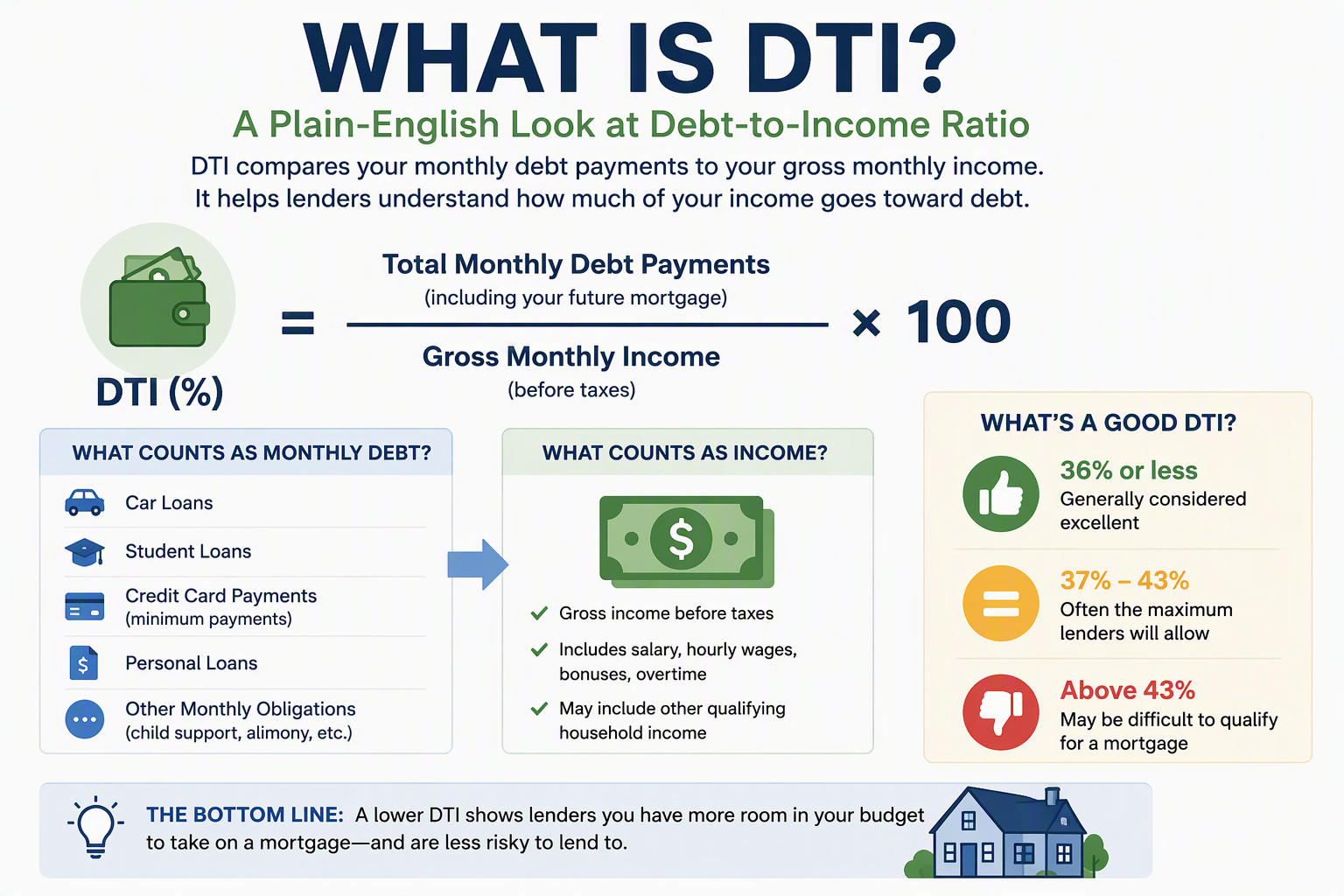
What Is DTI? A Plain-English Look at Debt-to-Income Ratio
DTI, or debt-to-income ratio, is one of the most important parts of any mortgage affordability calculator.
Put simply, DTI compares your total monthly debt payments to your gross monthly income. Lenders use it to decide whether the monthly payment fits your financial picture.
For many loan programs, lenders want your total monthly debt obligations, including the new mortgage payment, to stay below 43% of gross monthly income.
Here’s a simple example:
- Gross monthly income: $8,000
- Maximum total debt at 43% DTI: $3,440
If you already have:
- Car payment: $450
- Student loans: $300
- Credit card minimums: $150
That’s $900 in existing monthly debt.
Using that example, the remaining amount available for your future housing payment would be about $2,540 per month.
That payment has to cover more than just the loan. It usually includes taxes, insurance and possibly mortgage insurance too.
Why this matters
A lot of buyers focus on home price first. Lenders start with monthly payment capacity.
That shift matters. If your debt is high, your buying power shrinks. If your debt is low, you may qualify for more than expected.
Still, qualifying for a payment and being comfortable with it are not the same thing. We’ll get to that gap shortly.
Why Interest Rate Matters More Than Most Buyers Realize
This is the affordability factor buyers feel the fastest.
A 1% rate difference on a $400,000 loan can change the monthly principal and interest payment by roughly $250 per month. Over the life of a 30-year loan, that can add up to more than $90,000.
That’s not a rounding error. That’s the difference between a payment that feels manageable and one that feels tight every single month.
A simple example
Using rough estimates on a 30-year fixed mortgage:
- $400,000 loan at 6.0%: about $2,398/month for principal and interest
- $400,000 loan at 7.0%: about $2,661/month for principal and interest
That’s a difference of about $263 per month.
Now add taxes, insurance and any PMI, and the full monthly payment climbs further.
What buyers should take from this
If rates move, your target price may need to move too.
This is also why it helps to run multiple scenarios in a home affordability calculator PA buyers can use with current assumptions. A realistic estimate gives you more control than a vague rule ever will.
Down Payment Realities in 2026
A lot of buyers still assume they need 20% down to buy a home. That keeps people on the sidelines longer than they need to be.
In reality, minimum down payment requirements vary by loan type.
Common minimums buyers should know
- Conventional loans: often 3% to 5%
- FHA loans: typically 3.5%
- VA loans: often 0% for eligible buyers
These are common baseline standards, but loan guidelines can vary by lender, credit profile and program details. Buyers should always confirm current requirements with a lender before making a decision.
How down payment size affects affordability
Your down payment changes three things at once:
Your loan amount
More down means less borrowed.
Your monthly payment
Less borrowed usually means lower monthly principal and interest.
Your mortgage insurance cost
With conventional financing, putting less than 20% down often means PMI. A higher down payment can reduce that cost or remove it entirely once equity requirements are met.
So if you’re asking, how much house can I buy, the better question is really this: how much do I want my monthly payment to be, and how does my down payment shape that?
That’s a much more useful lens.
Property Taxes and Insurance in Central PA
Taxes and insurance are where broad affordability rules really start to fall apart.
Buyers shopping across South Central Pennsylvania can see meaningful differences in monthly cost depending on county, municipality, school district and the home itself.
Here are rough county-level property tax and insurance expectations buyers should be prepared for. These are planning ranges, not quotes, and should be verified before publishing and updated regularly.
Lebanon County
- Property taxes: often roughly 1.5% to 2.1% of home value annually
- Homeowners insurance: often roughly $900 to $1,400 per year
Lancaster County
- Property taxes: often roughly 1.3% to 1.9% annually
- Homeowners insurance: often roughly $900 to $1,500 per year
Cumberland County
- Property taxes: often roughly 1.4% to 2.0% annually
- Homeowners insurance: often roughly $900 to $1,400 per year
York County
- Property taxes: often roughly 1.5% to 2.2% annually
- Homeowners insurance: often roughly $950 to $1,500 per year
Dauphin County
- Property taxes: often roughly 1.6% to 2.3% annually
- Homeowners insurance: often roughly $950 to $1,500 per year
Perry County
- Property taxes: often roughly 1.4% to 2.0% annually
- Homeowners insurance: often roughly $950 to $1,450 per year
What this means in real dollars
On a $400,000 home, the difference between a 1.4% and 2.1% tax rate is about $2,800 per year, or roughly $233 per month.
That’s why location doesn’t just affect lifestyle. It affects payment.
If you’re comparing communities in Lancaster, Lebanon, Cumberland, York, Dauphin or Perry County, you need those local costs in the conversation early, not after you fall in love with a floor plan.
What You Can Afford on Paper vs. What Feels Comfortable
This is the part buyers appreciate most once they see the numbers.
There’s a difference between maximum affordability and comfortable affordability.
A lender may approve you up to a certain threshold based on income and DTI. But your actual comfort range depends on how you live. If you’re saving for childcare, traveling often, supporting family or just prefer more breathing room every month, the highest possible approval amount may not be the right target.
We see this all the time. Buyers ask, “What’s the max?” Then the better question shows up right after it:
“What payment would still let us live the way we want to live?”
That’s the right question.
A home should give you confidence, not constant financial tension. More value. More control. More confidence. That’s the standard we want buyers to use.
The Practical Next Step: Use Our Buyer Power Calculator
If you want a better answer than a rule of thumb, start with real numbers.
Our Buyer Power Calculator helps you estimate:
- Your purchase power
- Your estimated monthly payment
- Different budget scenarios based on your inputs
It’s a practical first step for buyers who want clarity before talking with a lender or touring homes.
Whether you’re early in the process or actively comparing communities, the calculator gives you a better sense of what may work based on your income, debts and financing assumptions.
What the Buyer Power Calculator Tells You, and What It Doesn’t
A good calculator is useful because it gives buyers structure. It is not useful if buyers mistake it for a final loan decision.
What it tells you
Our buyer power calculator can help estimate:
- A home price range based on your income and debt inputs
- An estimated monthly housing payment
- How changes in down payment, rate or debt can affect your range
- Budget scenarios that help you compare options
That makes it a strong planning tool.
What it does not tell you
It does not provide:
- A formal pre-qualification
- A loan approval
- A locked interest rate
- A final tax or insurance quote
- A guaranteed monthly payment
Those next-step numbers come from a lender and from the specific home, homesite and financing structure you choose.
Still, the calculator helps you start smarter. It replaces guessing with a clearer range.
What to Do After You Use the Calculator
Once you’ve used the calculator, the next steps should stay simple.
1. Talk to a preferred lender for a real pre-qualification
This is where your estimated range becomes a verified range.
A lender can review your income, debts, credit and loan options, then help you understand what financing programs fit best.
2. Tour homes within your comfort range
Not your max. Your comfort range.
That matters because the right home is not just one you can technically buy. It’s one you’ll feel good owning month after month.
At Garman, we build homes that are Built for the Way You Live. That includes helping buyers think beyond the price tag and into the full cost of ownership, comfort and long-term value.
3. Explore Garman Pathways™ if you want flexibility
For buyers who want a smarter way forward, Garman Pathways™ gives you room to explore with more clarity and less pressure.
It’s part of how we help buyers move forward with more control and more confidence, especially in a market where rates and monthly payments matter as much as purchase price.
We’re not here to push you into the biggest number. We’re here to help you find the right one.
A Better Way to Start Your Home Search
The best answer to how much home can I afford is not a generic multiplier. It’s a monthly number shaped by your income, debt, down payment, rate and local ownership costs.
That’s the number that helps you shop with confidence.
If you’re starting your search in South Central Pennsylvania, use our Buyer Power Calculator first. It’s the easiest way to turn a vague question into a practical starting point. Then, when you’re ready, connect with our team to explore communities, available homes and smarter ways forward through Garman Pathways™.
FAQs
How much house can I afford based on my salary?
Your salary is only one part of the answer. Lenders also look at your monthly debt, down payment, interest rate, property taxes, homeowners insurance and loan type. A home affordability calculator gives a much better estimate than a simple income multiplier.
What is a good debt-to-income ratio for buying a home?
For many loan programs, lenders want your total monthly debt obligations, including your future mortgage payment, to stay below 43% of gross monthly income. Some loan scenarios may vary, but 43% is a common benchmark buyers should know.
How does a down payment affect my monthly mortgage payment?
A larger down payment reduces the amount you borrow, which usually lowers your monthly payment. It can also reduce or eliminate PMI, depending on the loan type and how much equity you start with.
Why does interest rate matter so much when buying a home?
Even a 1% change in interest rate can make a major difference in monthly payment. On a $400,000 loan, that difference is roughly $250 per month, which can add up to more than $90,000 over a 30-year loan.
What does a home affordability calculator include?
A home affordability calculator typically uses your income, debts, down payment, estimated interest rate and other housing costs to estimate your price range and monthly payment. It’s a planning tool, not a loan approval.
Is the Buyer Power Calculator the same as pre-qualification?
No. The Buyer Power Calculator gives you an estimate based on the numbers you enter. It does not verify your finances, approve a loan or lock an interest rate. You’ll need to speak with a lender for formal pre-qualification.
What should I do after using a mortgage affordability calculator?
After using a calculator, talk with a lender to confirm your financing options, then focus your home search on a payment range that feels comfortable, not just the highest amount you may qualify for. If you’re exploring new construction, it also helps to compare communities, taxes and long-term ownership costs.
Latest Posts
October 23, 2026
New Home First Year Problems: What's Normal and What Needs a Warranty Call
October 23, 2026
Questions to Ask a Home Builder: A Practical Checklist for Comparing Home Builders
October 23, 2026
How to Build a Flexible Home Buying Plan (Even When Life Doesn't Cooperate)
October 23, 2026
What Makes a Home a Good Long-Term Fit: A Buyer's Guide to Judging Value Beyond the Purchase Price
October 23, 2026
Should I Wait to Buy a House? What Waiting Really Costs and Gains
October 14, 2026
How to Make the Most of Garman Builders' Online Design Center
October 9, 2026
New Home Builder Incentives Explained: How to Compare Flex Cash, Rate Buydowns, Design Credits and More
October 9, 2026
When to Start Touring Homes: Signs You Are Ready to See New Homes in Person
October 9, 2026
Why Are New Homes So Expensive? A Buyer's Guide to What Goes Into the Price
Previous Article


 0
0