


Nest Notes
New Home Builder Incentives Explained: How to Compare Flex Cash, Rate Buydowns, Design Credits and More

October 9, 2026
New Home Builder Incentives Explained: How to Compare Flex Cash, Rate Buydowns, Design Credits and More
Incentives can save you real money, but comparing them can feel like comparing apples to oranges. One offer knocks dollars off the price. Another lowers your rate. A third hands you a credit to spend at the design studio. They all sound good on paper, and they all solve a different problem, which is exactly why they're hard to line up side by side.
This guide breaks down the most common builder incentives, what each one actually does to your numbers, and how to figure out which one matters most for your specific situation. We'll walk through flex cash, rate buydowns, design credits, closing cost support, and price reductions, then give you a simple way to compare them that isn't just "which number is bigger."
A quick note before we start: every dollar figure in this article is a round, illustrative example used to show how the math works. It is not a real offer, and it isn't financial advice. Always run your own numbers with your lender before deciding what fits your budget.
Key Takeaways
- Flex cash is the most flexible incentive because you decide where it goes, whether that's closing costs, a rate buydown, or design studio upgrades.
- A rate buydown lowers your monthly payment, which matters more to buyers who are watching their budget month to month rather than their upfront cash.
- Design credits only have value if you were already planning to spend on upgrades. If you weren't, the credit doesn't save you anything you'd have spent otherwise.
- Closing cost support reduces the cash you need on settlement day, which is the incentive that matters most to buyers who are cash-tight going into the purchase.
- A price reduction is the only incentive that touches your loan amount, your down payment, and your property taxes all at once.
- The only fair way to compare incentives is to convert each one into its effect on your monthly payment and your cash needed at settlement, then compare those two numbers side by side.
- Before choosing an incentive, ask whether it requires a specific lender, whether it has a deadline, and whether it can be combined with other offers.
- The best incentive isn't the one with the biggest headline number. It's the one that relieves whatever is putting the most pressure on your budget right now.
What Flex Cash Actually Covers
Flex cash is exactly what it sounds like: a set dollar amount the builder offers that you get to direct where it does the most good. Unlike an incentive that's locked into one use, flex cash usually works across a few different categories, such as closing costs, a rate buydown, or upgrades at the design studio.
Say a builder offers $10,000 in flex cash. You could put all of it toward closing costs if cash at settlement is your tightest spot. You could split it, using half to buy down your rate and half for flooring upgrades. Or you could put the whole thing toward a buydown if your monthly payment is the number keeping you up at night.
That flexibility is the whole point, and it's why flex cash is often the easiest incentive type to evaluate. You're not trying to figure out if a rate buydown is "worth more" than a closing cost credit. You get to run both scenarios yourself and pick the one that helps the most.
How a Rate Buydown Changes Your Payment
A rate buydown lowers your interest rate, either for the first few years of the loan or for its entire life, depending on the structure. A lower rate means a lower monthly payment, and for most buyers, the monthly payment is the number that decides whether a home feels affordable.
Here's a simple illustration. On a $400,000 loan at 6.5%, the principal and interest payment runs around $2,528 a month. Buy that rate down to 5.5%, and the payment drops to roughly $2,271 a month. That's about $257 a month back in your pocket, or just over $3,000 a year, for as long as the buydown lasts.
Temporary buydowns, often structured as 2-1 or 1-0 programs, lower the rate for the first one or two years and then step up to the permanent rate. These work well for buyers who expect their income to grow or who want breathing room while they settle into a new home and a new payment. A permanent buydown lowers the rate for the life of the loan, which costs more upfront but delivers savings for as long as you hold the mortgage.
When buyers ask us whether a rate buydown vs price reduction makes more sense, the honest answer is that it depends on what you're optimizing for. A buydown is a payment tool. A price reduction is a loan-amount tool. They solve different problems, and we'll get into exactly how to tell them apart later in this guide.
Design Credits: Money for the Studio, Not the Mortgage
A design credit is a dollar amount applied toward upgrades and selections at the design studio, things like flooring, cabinetry, countertops, fixtures, or structural options. It doesn't touch your loan amount or your monthly payment directly. It changes what you can afford to put into the home itself.
This is the incentive that depends most heavily on your own plans. If you were already budgeting for upgraded countertops or a finished basement, a design credit for $10,000 just saved you $10,000 in out-of-pocket spending on selections. That's real value.
But if you were planning to build with mostly standard selections, a design credit toward upgrades doesn't save you money. It gives you an incentive to spend more than you otherwise would have. That's not necessarily bad, but it's worth being honest with yourself about whether you're taking the upgrade because you wanted it anyway or because the credit is sitting there.
Walking through the design studio with a clear sense of what you want before you know what the credit covers helps keep this decision grounded in your actual needs rather than the incentive itself.
Closing Cost Support: More Cash in Your Pocket at Settlement
Closing cost support lowers the amount of cash you need to bring to the table on settlement day. Closing costs on a new construction home can run anywhere from 2% to 5% of the purchase price, which on a $450,000 home could mean $9,000 to $22,500 due at closing, on top of your down payment.
If a builder offers $8,000 in closing cost assistance, that's $8,000 less cash you need to have saved and ready before you can close. For buyers who have the income to support a payment but are stretched on upfront savings, this is often the incentive that matters most, because it's the one that can be the difference between closing on time and not closing at all.
This type of incentive doesn't touch your rate or your loan amount. It's purely about what's required in cash versus what's financed.
Price Reductions: Lowering the Number Itself
A price reduction is the most straightforward incentive to understand and the only one that affects three parts of your budget at once: the loan amount, the down payment, and the property taxes tied to the purchase price.
Take a $20,000 price reduction on a $450,000 home. The new price is $430,000. If you're putting 10% down, your down payment drops from $45,000 to $43,000, a savings of $2,000 in cash. Your loan amount drops from $405,000 to $387,000, which lowers your monthly principal and interest payment by roughly $126 a month at a 6.5% rate. And because property taxes are typically assessed based on purchase price, your annual tax bill may be lower too, depending on local assessment practices.
A price reduction is the only incentive on this list that works on all three fronts simultaneously, even if each individual effect is smaller than what a buydown or a cash credit might deliver on its own.
How to Compare Builder Incentives: L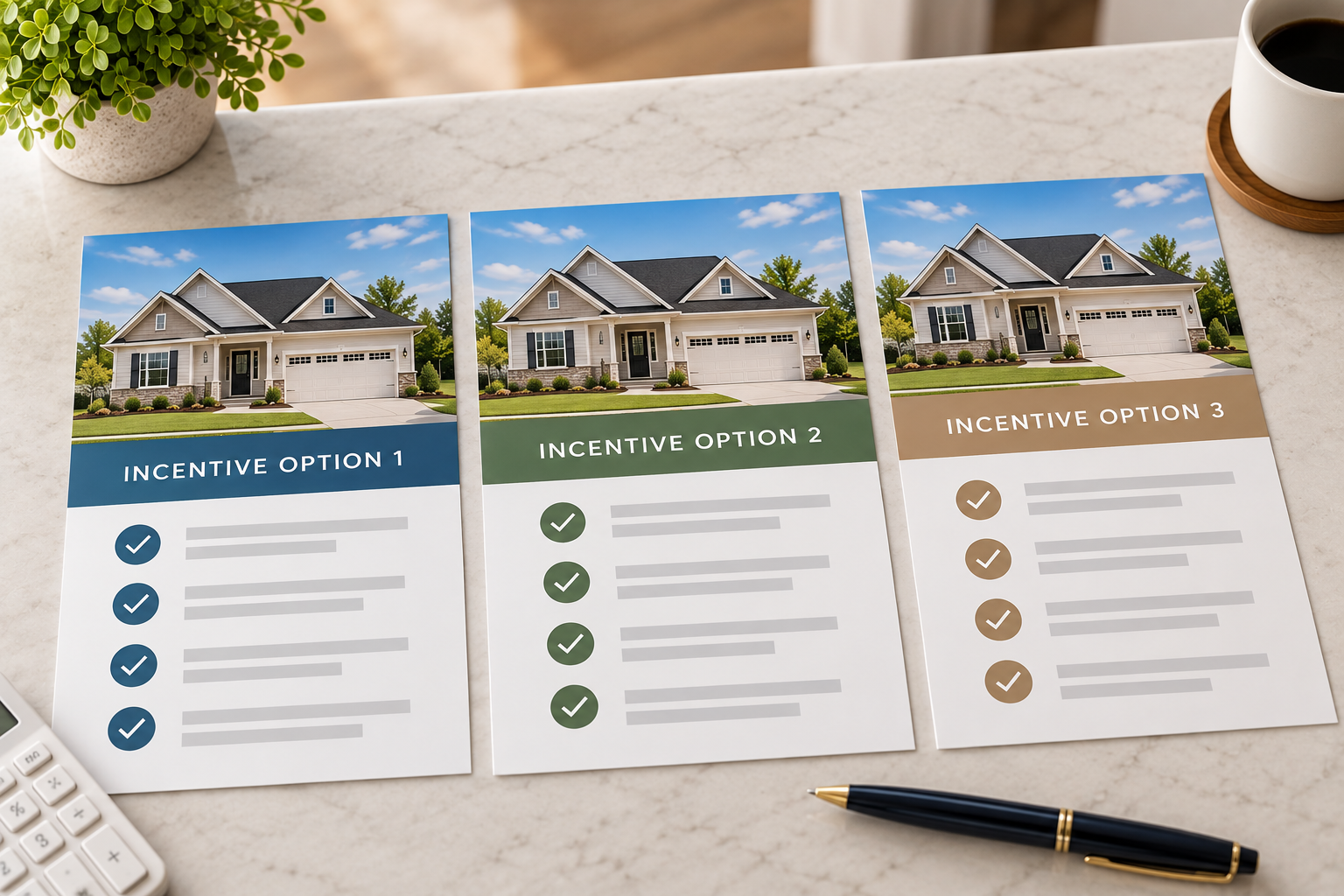 ine Them Up by What They Actually Do
This is where most comparisons go wrong. Buyers see "$15,000 in flex cash" against "rate as low as 5.5%" against "$10,000 price reduction" and try to compare the headlines. The headlines aren't the same unit of measurement, so comparing them directly doesn't tell you much.
The fix is to convert every incentive into two numbers: what does it do to your monthly payment, and what does it do to your cash needed at settlement? Once every incentive speaks the same language, the comparison gets a lot easier.
Here's how that looks in practice:
- Flex cash: Run it both ways. What's the monthly payment impact if it goes to a buydown? What's the cash impact if it goes to closing costs? Compare both outcomes.
- Rate buydown: Monthly payment impact only. No effect on cash needed at settlement unless the buydown itself requires an upfront cost you're covering separately.
- Design credit: No effect on payment or cash at settlement. Its value is measured against what you would have spent on upgrades anyway.
- Closing cost support: Cash needed at settlement only. No effect on the ongoing monthly payment.
- Price reduction: Touches both. Lower down payment, lower monthly payment, and potentially lower taxes.
Once you've run each incentive through these two filters, you can compare apples to apples. A $10,000 price reduction and a rate buydown that saves you $150 a month aren't naturally comparable until you translate the price reduction into its own monthly payment savings, and then they are.
Which Incentive Tends to Fit Which Buyer
Different incentives solve different problems, and the right one usually depends on where your budget is tightest.
Cash-tight buyers, meaning those who have the income to support a mortgage payment but are working with a smaller amount of available savings, tend to get the most value from closing cost support. It directly addresses the part of the process that's hardest for them: coming up with enough cash to close.
Payment-focused buyers, who are comfortable with their savings but watching every dollar of their monthly budget, usually get more out of a rate buydown. Even a modest buydown can mean the difference between a payment that feels comfortable and one that feels tight every month for years.
Buyers planning real upgrades, who already intended to spend on things like upgraded flooring, a finished lower level, or higher-end fixtures, often get the most practical value from design credits. That credit offsets spending they were going to do anyway, which makes it close to free money in their specific case.
There's no universal "best" incentive here. There's only the incentive that lines up with the pressure point you're actually feeling.
Questions to Ask Before You Choose an Incentive
Before you lock in on any offer, a few questions will keep you from finding out too late that the incentive doesn't work the way you assumed:
- Does this incentive require using a specific lender? Some rate buydowns and closing cost credits are tied to a preferred or affiliated lender. That's not automatically a dealbreaker, but you should compare that lender's rate and terms against outside options before assuming the incentive is a net win.
- Is there a deadline tied to this offer? Incentives are often tied to a contract date, a specific inventory home, or a closing window. Know the deadline before you build your plans around it.
- Can this incentive be combined with others? Some builders allow flex cash, closing cost help, and design credits to stack. Others cap the total incentive value or require you to choose one. Ask directly rather than assuming.
A Simple Side-by-Side Worksheet
Use this layout to compare any set of incentives you're considering. Fill in your own numbers for each offer on the table.
| Incentive | Effect on monthly payment | Effect on cash at settlement | Requires specific lender? | Deadline? | Can combine with other offers? |
|---|---|---|---|---|---|
| Flex cash | |||||
| Rate buydown | |||||
| Design credit | |||||
| Closing cost support | |||||
| Price reduction |
Fill in every row you can, even with rough estimates. Once the table is complete, look at which column matters most to you right now, whether that's the monthly payment column or the cash at settlement column, and let that guide your decision rather than the size of the headline number.
The Best Incentive Is the One That Relieves Your Biggest Pressure Point
There's no incentive that's objectively better than the others. A $15,000 flex cash offer isn't automatically stronger than a rate buydown, and a price reduction isn't automatically stronger than closing cost support. Each one solves a specific problem, and the value only shows up if that problem is actually yours.
The buyers who end up happiest with their choice are the ones who got honest about where their budget was tightest before they compared a single offer. Start there, not with the headline number.
If you're weighing incentives on a specific home or community and want help running the real numbers for your situation, our team can walk through your financing options and current offers with you. We'd rather you understand exactly what an incentive does for your budget than take our word for it.
Frequently Asked Questions
What is flex cash on a new construction home?
Flex cash is a set dollar incentive a builder offers that you can apply toward more than one use, typically closing costs, a rate buydown, or design studio upgrades. You decide where it provides the most value for your situation.
Is a rate buydown better than a price reduction?
Neither is universally better. A rate buydown only affects your monthly payment. A price reduction affects your loan amount, down payment, and monthly payment, and potentially your property taxes. The right choice depends on whether your bigger concern is upfront cash or ongoing payment.
Can builder incentives be combined?
Sometimes. It depends on the specific offer and builder. Always ask directly whether flex cash, closing cost support, design credits, and rate buydowns can be stacked or whether you have to choose one.
Do incentives require using the builder's preferred lender?
Some do, particularly rate buydowns and certain closing cost credits. Before accepting, compare the preferred lender's rate and fees against other lenders to confirm the incentive is still a net benefit.
How do I know which incentive saves me the most money?
Convert each incentive into its effect on your monthly payment and your cash needed at settlement. Once every offer is measured in those same two terms, you can compare them directly instead of comparing unrelated headline numbers.

 0
0