


Nest Notes
How Much Equity Do You Need to Buy Your Next Home?

October 2, 2026
How Much Equity Do You Need to Buy Your Next Home?
There is no single number. The equity you need depends on the price of the next home, the down payment you want to make and the payment you are comfortable carrying every month. Three different homeowners with three different goals will land on three different answers, and that is the point. Here is how to work it out for yourself.
If you own a home in South Central Pennsylvania and you are wondering whether you can move up, this guide walks through the math in plain terms. We will turn your equity into an estimated net proceeds number, show how that number becomes a down payment, and explain how it shapes the monthly payment you will actually live with. By the end, you will have a way to test real numbers instead of guessing.
Key Takeaways
- Equity is what your home is worth minus what you owe. It is not the same as cash in hand until the home sells and the costs of selling are paid.
- Net proceeds, not equity, is the number that actually becomes your next down payment.
- A larger down payment lowers your loan amount and your monthly payment, and reaching 20 percent down removes mortgage insurance on a conventional loan.
- Selling costs such as agent commission, transfer taxes and closing costs vary by county and municipality, so treat any percentage as an estimate until your agent and title company confirm it.
- Thin equity does not rule out a move. A Quick Move-In home, a builder incentive, or an extra season in your current home can all change the math.
- Having enough equity to qualify is not the same as being comfortable with the payment. Both questions matter.
- Lenders weigh income, debt, credit and cash reserves alongside your down payment, so equity is one piece of a larger picture.
- The Buying Power Calculator lets you test your expected net proceeds against a few different home prices before you commit to anything.
What Equity Actually Is
Home equity is what your home is worth today minus what you still owe on it. If your home is worth $350,000 and your mortgage balance is $230,000, you have $120,000 in equity. That is the simple version, and it is the version most people stop at.
But equity on paper is not the same as money in your pocket. You cannot hand a lender your equity directly. You have to sell the home, pay off the mortgage, cover the costs of selling, and whatever is left over is what you actually have to work with. That leftover number is called net proceeds, and it is the one that matters when you are planning your next move.
Turning Equity Into Net Proceeds
Net proceeds is your estimated sale price, minus your mortgage payoff, minus the costs of selling. Those selling costs typically include agent commission, transfer taxes, title fees and other closing costs, and they vary by county and municipality across Pennsylvania. Your real estate agent and title company can give you accurate figures for your specific location, so treat any numbers here as illustrative only.
Here is a simple, rounded example to show how the math works:
- Estimated sale price: $400,000
- Mortgage payoff: $250,000
- Estimated selling costs: $30,000
- Estimated net proceeds: $120,000
That $120,000 is what actually shows up to help fund your next home. It is lower than the $150,000 of raw equity in that example, because selling a home costs money. Anyone budgeting off their equity number instead of their net proceeds number is likely overestimating what they have to work with.
How Net Proceeds Become a Down Payment
Once you know your estimated net proceeds, you can decide how much of it to put down and how much to keep in reserve. The relationship is straightforward: a larger down payment means a smaller loan, and a smaller loan means a lower monthly payment.
There is also a meaningful line at 20 percent down on a conventional loan. Below that threshold, lenders typically require private mortgage insurance, an added monthly cost that protects the lender, not you. Reach 20 percent down and that cost goes away, which is one reason move-up buyers pay close attention to this number specifically.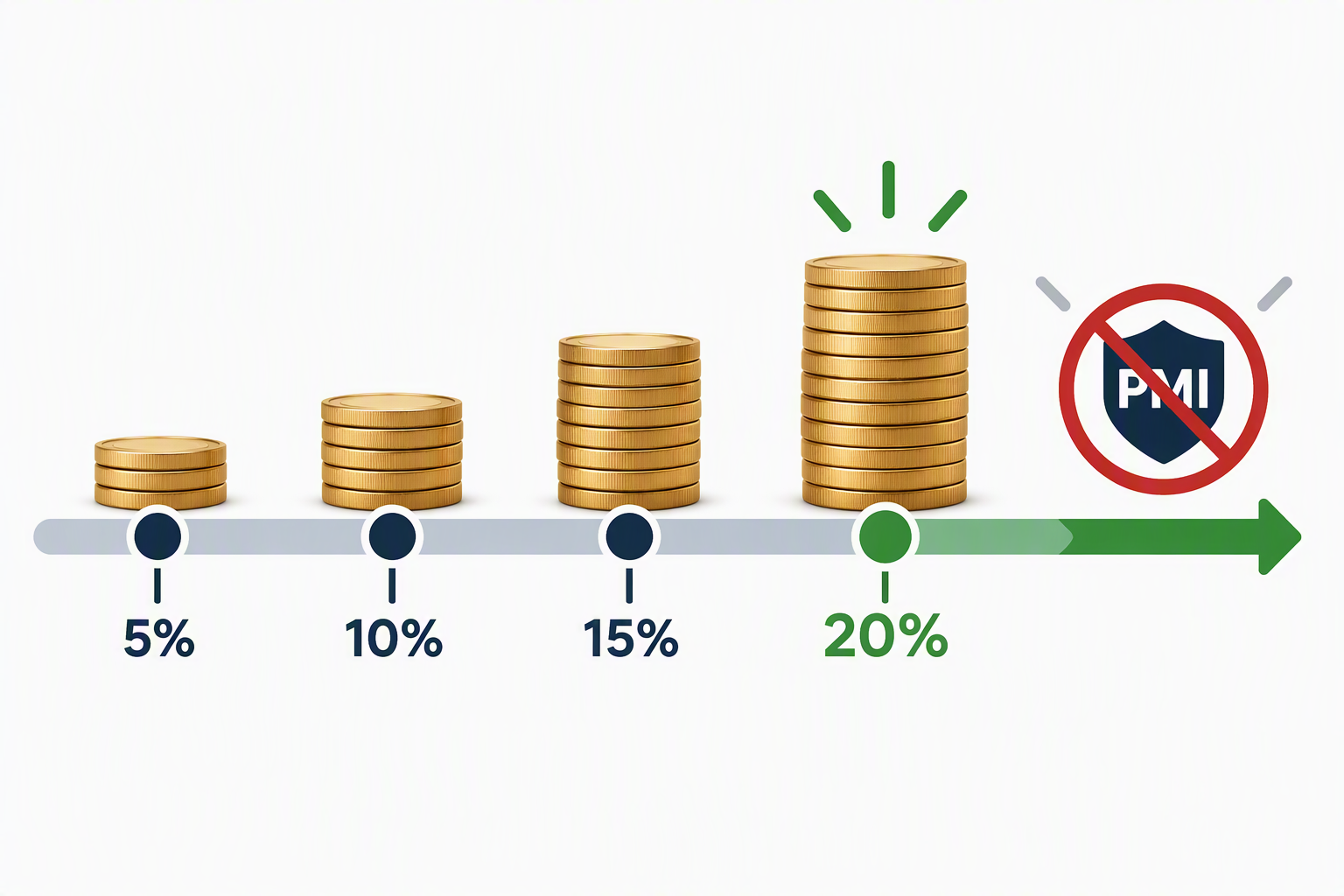
Using the example above, $120,000 in net proceeds on a $450,000 new home would put you at roughly 27 percent down, well past the 20 percent mark. The same $120,000 on a $600,000 home would land closer to 20 percent. The home price and the equity number are always working against each other, which is exactly why this has to be calculated, not assumed.
Three Equity Scenarios, and What Each One Could Mean
Every homeowner's equity position is different, so here are three illustrative scenarios applied to a sample new home price of $450,000. None of these figures represent a typical or expected amount of equity. They are simply here to show how the math moves.
Modest equity: around $40,000 in net proceeds
On a $450,000 home, that puts you around 9 percent down. You would likely be financing with mortgage insurance included, and the monthly payment would reflect a larger loan balance. Still workable, but worth running through a lender to see the real payment.
Moderate equity: around $90,000 in net proceeds
That is 20 percent down on a $450,000 home, right at the line where mortgage insurance drops off a conventional loan. This is often the scenario where buyers feel the most balance between down payment size and cash kept in reserve.
Strong equity: around $150,000 in net proceeds
That is more than 33 percent down on a $450,000 home. You would have room to either lower your monthly payment further or shift toward a higher-priced home while keeping the same comfortable payment.
If Your Equity Is Thin, You Still Have Options
Not everyone is sitting on moderate or strong equity, and that is worth saying plainly instead of glossing over. If your net proceeds estimate comes in lower than you hoped, a move is not automatically off the table.
A Quick Move-In home priced below your target can close the gap without changing your location or your lifestyle goals. Builder incentives, including flex cash or finished-basement bonuses that rotate through our current offers, can also stretch what your proceeds can do. And sometimes the honest answer is to wait another season. Home values in South Central Pennsylvania have been appreciating steadily, and a few more months of paying down principal and watching your home's value move can meaningfully change your equity position. None of these are failures. They are just different paths to the same destination.
Equity Versus Comfort: Two Different Questions
Qualifying for a loan and feeling good about the payment are not the same thing. A lender can approve you for a payment that technically fits their debt-to-income guidelines while still leaving you tighter than you want to be month to month.
Run your own comfort test alongside the qualification test. Look at what you are spending now, what you want to keep spending on things that matter to you, like travel, savings or simply breathing room, and make sure the new payment leaves that intact. Equity tells you what you can afford to put down. Your own budget tells you what payment you actually want to carry.
What Else Lenders Look At
Equity and down payment are only part of what a lender evaluates. Income stability, existing debt, credit history and cash reserves after closing all factor into both your approval and your interest rate. Two buyers with identical down payments can get different loan terms based on these other factors.
This is exactly why a down payment number, however solid, should be checked against a real financing conversation before you treat it as final.
Put Your Numbers to the Test
The fastest way to move from estimating to knowing is to run your expected net proceeds through our Buying Power Calculator. Enter your estimated available funds and test it against a few different home prices, including the ones on your list and a couple just above and below it. You will see how the down payment, loan amount and estimated monthly payment shift with each scenario, using your actual numbers instead of a stranger's example.
Equity is a tool for planning your next move, not a test you pass or fail. Whether your proceeds are modest, moderate or strong, there is a path forward that fits, and the only way to find it is to run the real numbers. Reach out to our team to walk through your specific situation, or start with the Buying Power Calculator today.
FAQ
How much equity do I need to buy a new home?
There is no fixed amount. The equity you need depends on your target home price, how much you want to put down and the monthly payment you are comfortable with. Run your estimated net proceeds through a buying power calculator to see what different home prices and down payments actually look like for you.
Is my home equity the same as my down payment?
Not exactly. Your equity becomes your down payment only after you sell, pay off your mortgage and cover selling costs like agent commission, transfer taxes and closing fees. What is left over is called net proceeds, and that is the number to use when planning your next purchase.
Do I need 20 percent down to buy my next home?
No, but reaching 20 percent down on a conventional loan removes private mortgage insurance, which lowers your monthly payment. Many move-up buyers aim for this threshold, though it is not a requirement to qualify for financing.
What if I don't have enough equity to move up?
You still have options. A Quick Move-In home priced below your original target, current builder incentives, or simply waiting a season to build more equity can all close the gap without taking a move off the table entirely.
What else do lenders consider besides equity?
Lenders look at your income, existing debt, credit history and cash reserves in addition to your down payment. Two buyers with the same equity can qualify for different payments and rates depending on these other factors.

 0
0